Sunday Cycling And Heartfelt Prayer
“Every thought we think is creating our future.” — Louise Hay
Yesterday I went for my Sunday evening cycling after checking the air pressure and placing my nimbu pani in the rack. I left later than usual because the days are getting warmer. I said my usual prayers for protection and safety, feeling the intention in my heart. I hesitated about the route. Paused, to feel my way as I faced the T point in the road, and intuitively chose the left turn, which inadvertently committed me to a longer circuit.
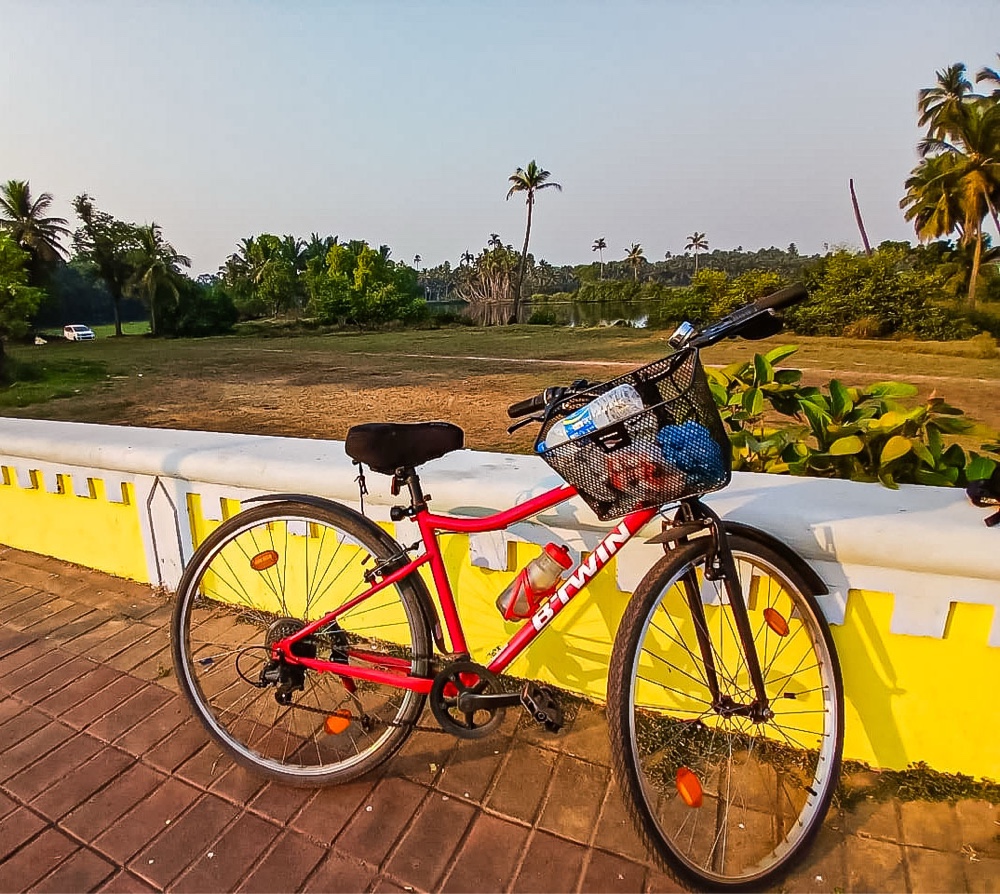
I now realise that I had expected intuition to warn me of fatigue. But perhaps intuition is not always a clear bell; it is often braided with what we want to do. On Sundays I want the river, the longer stretch, the sense of freedom — and in that wanting I override body signals. Awareness, I am learning, arrives more often after the episode than before it. After one takes the risk.
When I reached the Chapora river, I started feeling the energy sag. I didn’t stop to rest, but cycled slowly past the river enjoying the scene. Then, a short while later, the phone rang. When I got off the cycle to answer it, I became extremely dizzy and nauseous. My cycle fell and the belongings in the basket spilled onto the narrow village road. I don’t know how I managed, but I picked up the stuff and the cycle and slowly moved shuffled off the road—almost on my knees, to sit down on a large laterite stone. It wasn’t a clean space; there was bramble and weeds and some dry garbage too, but it was all there was. And it was a relief to sit after that scary dizzy spell.
Some women came out of their homes to ask what happened. I said I was dizzy; they enquired about my blood pressure, but thankfully I don’t have those issues. I requested some water. Deepali, dressed in a bright leaf‑green maxi dress, bought me a bottle of ice‑cold drinking water from a shop five steps from where I sat. Before I left, I paid her for it.
Pouring the chilled liquid over my head, doubting my ability to cycle home, I asked if she knew anyone who could cycle while I walked behind. She was ambivalent. Just then two boys came cycling home. She spoke to them and they tried to help. The cycle was too high and the taller boy stood and pedaled, while the younger followed on their cycle. But, they were only willing to take it a few yards down the road. I was still very far from home.
In the year 2000, I started learning Reiki, which did one very phenomenal thing for me. It gave me permission to ask for what I wanted. This was something I had never really done in my life till then. I had never really stepped up and asked for what I wanted. There wasn’t any dearth of wanting, but having clarity and asking or intending wasn’t part of my upbringing. If there were problems we faced them; we did mantras and consulted astrologers, but praying for an outcome wasn’t learnt. Reiki showed us how to heal ourselves by touching the body and also how to extend healing through energetic means—envisaging the person or idea, taking their name, visualising the desired outcome and sending energy through the aether.
I have been doing this for twenty‑six years now. Sometimes it works brilliantly—a breech baby is turned. A suicidal man opens the door to the room he’s locked himself in. These feel like miracles. And sometimes it doesn’t seem to work in quite the same way—with a tangible positive outcome. I face resistance from people to accept the wisdom of the intention, to slow down, to see what is coming up not as a negative implication but as latent material surfacing to be healed. It is difficult to explain how this works because science cannot quantify what spiritual teachers speak of, what Mikao Usui, the founder of Reiki, learnt and shared.
This has made me turn a sceptical lens upon the very idea of healing—wanting something tangible, something provable, so that one can help others overcome their doubt, as well as steady one’s own often wavering conviction. I have therefore been scrutinising this whole concept of energetic healing—whether it really has the power that so many teachers have vouched for. Can our lived experiences be proof enough, or do we need science to catch up and give us measures of certifiable evidence of its effectiveness?
I was disappointed that the boys didn’t take the cycle far enough. It was not the rescue I had hoped for. But Usui’s precept—Just for today, do not worry—came back to me. Help did not arrive in the form I expected. It arrived in fragments. A few yards here. A bottle of water there. A stone to sit on.
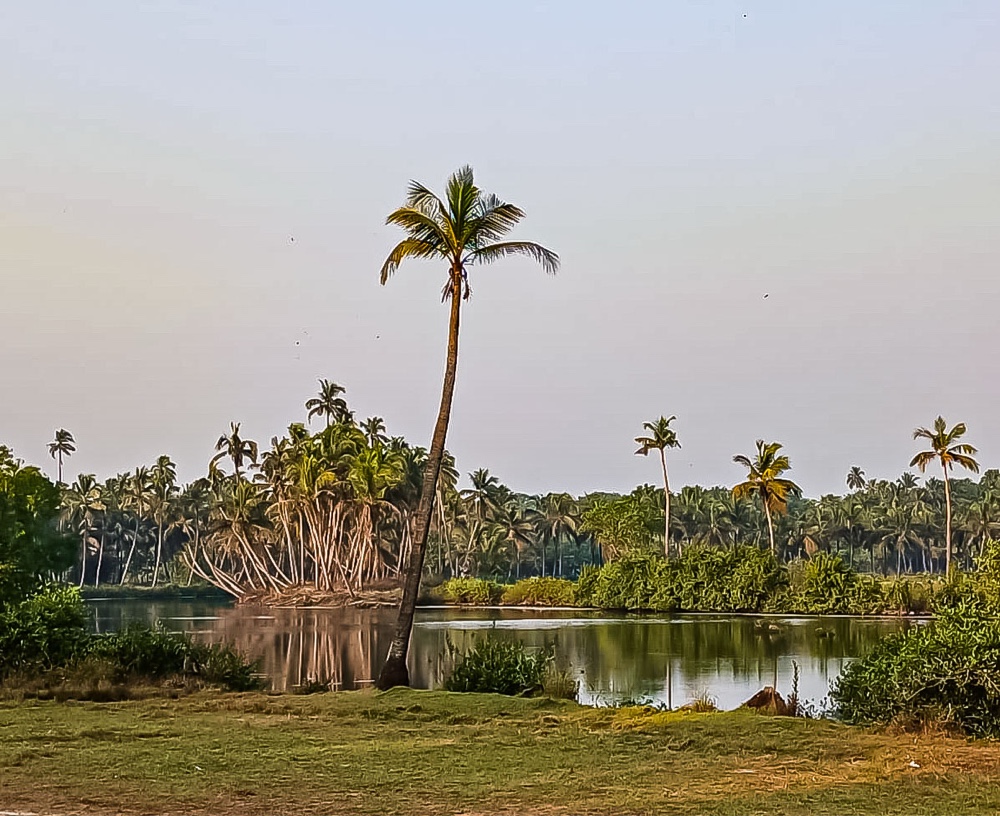
I wanted to give the children money to buy chocolates for themselves, but they refused, saying, “We have!” I didn’t want to insult their kindness so didn’t insist. I wasn’t feeling strong enough in any case. The nimbu pani with black salt and brief rest had revived me somewhat, so I walked with the cycle for a bit before cycling again until I reached a row of concrete benches, painted in cheerful orange and yellow, near the backwaters. I sat down watching birds—white egrets and black cormorants—flying westward into the pinking sky. Coconut palm trees bent towards the water as if thirsty for a sip. I rested and tried to gather strength in body and spirit. I stayed there longer than I realised, watching, letting the dizziness thin out, not quite praying but not entirely not praying either.
“Ask, and it will be given to you; seek, and you will find; knock, and the door will be opened to you.”— Gospel of Matthew 7:7
This teaching, attributed to Jesus from his Sermon on the Mount, seems misleading, and is possibly also why we would like to believe it’s as simple as this. But it actually implies that if we ask with sincerity, seek with awareness, knock with patience —and what one truly needs will reveal itself. The power seems to lie by aligning with the truth of your being—a knowing with such searing honesty that only the very evolved in this world—mystic, sages and yogis may be capable of.
I have observed that healing prayers as energy may be sent, that intention may be present like a prayer, but it is not always received in a way that affirms the power of healing we’d like to see. For something to be efficacious there has to be a realm of possibility within which it can be accepted with humility and acquiescence. The person, for whom the idea is being intended, has to be in a position to open their heart to listen to the guidance. Merely asking for healing does not always give us what we ask for.
There are times when sending up prayers for things, wanting something specific to manifest, provides insight that this isn’t necessarily the best thing for now—that what’s come in its place is better suited. I recall a healing client wanting to expand her business, and the feedback I was getting during the healing process showed me that it wasn’t what she could realistically handle. Sometimes we are given something and then realise it is not for us. Other times healing brings up reservations about healing itself. Sometimes it compels rest rather than forward movement. I have come to believe that healing is more complex than the creation of apparent miracles. But even so, I’m compelled to examine this again and again, primarily because I want reassurance that it is infallible—that it gives agency and control over one’s life. And I have a compulsion. To explore the truer meaning of “ask and it will be given to you.” As I have seen this more than once — that we ask, and something else arrives, and only later do we understand why.
After a short rest I started to walk the cycle slowly down the road that leads from Dandawado to Fernandez Wado. I still had twenty minutes of cycling to reach home. I couldn’t find enough energy to even mount the cycle. I stopped walking to see if there was anyone to help. It was scary. I was weak, light‑headed and still bilious, and this made me feel afraid. I didn’t allow the thoughts to surface then, but what if I had collapsed on the road, what if I couldn’t get home? I was quite petrified, and that added nervous overload to an exhausted body.
I asked some passersby but they didn’t respond. From a distance, at a bus stop, a man got up and headed towards me. He asked if I needed something and agreed to cycle as I walked behind. It was the best in that situation. He was getting up onto the cycle when someone drove right up to him and asked if he had a phone. I was in fear mode, so distrusted the man, thinking he was a scammer—unlikely on an inner village road in Goa, but fear isn’t logical. Ironically, he turned out to be a Samaritan from Bihar who took me on his motor bike right up to my building gate while Subbu from Kerala cycled behind us. They were friends—had known each other for twenty years. I was shaking as I got off his motorcycle and they stayed until I was steady enough to go up to my apartment. Reassured that the guard would assist me.
The cycle handle had become misaligned after it fell; the chain also came off. Subbu repaired these en route. When I offered to give them something, they refused. Their kindness felt like grace—yet I wondered: was this divine intervention based on my prayer before I started out, coupled with the energy I’d sent to my cycling in the morning—visualizing and feeling the intention? As Gregg Braden learnt from Tibetan monks, “The language that the Divine recognizes is not our spoken words, but the feeling in our hearts. When we feel the outcome as if it has already happened, we are speaking the language of prayer.” This is also what Mikao Usui taught, but it is definitely more complex than it sounds. Or maybe language obfuscates.
When Subbu stood up from the bus stop and came toward me without being called, it felt like what Braden describes—that heartfelt intention is not always spoken; it is felt. I had been asking internally for help long before I asked anyone aloud. The monks say that their prayers are never heard aloud, but felt—that true prayer is emotion made sincere. In that sense, my fear, my vulnerability, my quiet unarticulated asking were also prayers.
Or was it just coincidence, or maybe the result of simply opening up and asking strangers for help?
That Subbu’s hands were covered in grease but I was home safe made me wonder whether intention shapes events, or merely shapes the way we recognise help when it arrives. Subbu said that it was my positive energy that attracted the right help. Maybe?
The whole experience, despite much help along the way, didn’t reassure but rattled me. Did I have the agency to protect myself? Could I realistically rely on felt prayer and visualisation for assured outcomes? Or had this been just a freak event? These were the thoughts that kept me awake most of the night.
I revisited events in my life that hadn’t been about miraculous manifestation of perceived needs but a better understanding of myself. At the time, I felt my faith shatter on discovering inherited psychological patterns that had created the desire to pursue certain outcomes, which in the course of chasing had diminished my sense of self, leaving me experiencing shame for my naïveté and ignorance—for misunderstanding the spiritual dimension of being, for buying into myths and ideas our elders had perpetuated—possibly by misunderstanding the very concept of Christ saying: Ask, and it will be given to you; seek, and you will find; knock, and the door will be opened to you.”
My prayer for help was answered. I got help. My prayer for safety too was answered. Despite the fatigue and fear, my internal state helped me see and accept opportunities — where, as Jeffrey Allen, who teaches energy as medicine, says, “Prayer shifts your internal state. From that state, you notice opportunities and make different choices.”
And perhaps that is what this cycling ride—overcoming fear, asking for help, experiencing the entire gamut of what occurred—was about: that prayer didn’t override reality or correct my choices but made me receptive and responsive within the situation.
And that is prayer answered—the only assurance life can give. It certainly isn’t the most satisfying response. I’d have preferred that I’d been forewarned about my energy levels, taken a shorter route and prevented the damage rather than doing damage control. But the greater truth is that maybe I wasn’t ready to listen.
The route that follows the River Chapora for a short stretch is my favourite. I just love passing by and inhaling the riverness of being. I had done it effortlessly the week before. In addition I’d returned on Friday evening after three days at an Ayurvedic wellness spa, so I had hoped for more rather than less energy. However, I am habituated to pushing myself. Post‑Covid my energy levels have shifted. I’ve also been gaining weight and hope exercise will fix it. Fixated on this, I didn’t take into account a Zoom class I had conducted on Friday evening, the usual routine on Saturday with low‑intensity stretches to keep the bones moving, a three‑hour drive‑talk‑drive event, and then staying up until 2.30 am writing a review of the talk. Sunday cooking and sundry chores possibly added to the overload that I chose to ignore, because Sunday is the only day I dare to cycle—other days there is just too much traffic.
Perhaps I need to stop imposing my will and listen more. Understand my limits better. Accept them with grace. It seems foolish that I expect prayer to create awareness of my energy levels and can’t do this for myself, but that’s what happens when we are not willing to really listen.
This insight feels like the answer to a prayer that’s been lingering in my heart.
And yet, that nothing untoward happened and help was there is also grace. And if anything empowers us it is self-awareness—Gnōthi Seauton* Being the proverbial witness to oneself.
Not as a verdict, but as a practice: observe how one moves through the world, and let that observation refine the next choice—Yogaḥ karmasu kauśalam•.
Not infallible. Not definitive, but noticing, nonetheless—Sakshi
Bhava^
•Bhagavad Gita 2.50
buddhi-yukto jahātīha ubhe sukṛta-duṣkṛte
tasmād yogāya yujyasva yogaḥ karmasu kauśalam
A person established in wisdom lets go of both good and bad outcomes; therefore engage in yoga — yoga is skillfulness in action.
* Greek for Know Thyself—Understand your nature, limits, motives, and inner workings.
^Sanskrit—the state of being the witness.
This blog has been selected as one of the TOP 100 Life Blogs in 2025 by https://blog.feedspot.com/life_blogs/


Comments
Post a Comment